
Mission Metrics
AI Prompt Toolkit for Nonprofits
AI Prompt Toolkit for Nonprofits
Work With AI. Don’t Just Use It.
These nonprofit AI prompts are designed to help leaders solve operational problems, evaluate decisions, improve processes, and make better use of their organization’s resources. Rather than treating artificial intelligence as another writing tool, this toolkit shows how to work with AI as a practical extension of your leadership team.
Artificial intelligence isn’t changing what leadership is. It’s changing how quickly leaders can learn, analyze, communicate, and make better decisions.
For many nonprofit professionals, AI still feels like another technology trend. The conversation usually begins and ends with writing emails, creating social media posts, or drafting a grant proposal.
Those are useful applications.
They’re also the least interesting ones.
The real opportunity is much bigger.
AI can become one of the most valuable members of your leadership team—not because it replaces your judgment, but because it gives you more bandwidth to use your judgment where it matters most.
10 Nonprofit AI Prompts You Can Use Right Now
You don’t need to become an AI expert to start getting useful results.
The quality of an AI response depends heavily on the problem you give it, the context you provide, and the questions you ask next.
Here are ten nonprofit AI prompts you can adapt to work you’re already doing.
01 — IMPROVE A PROCESS
Prompt
I run a nonprofit process that works like this: [describe the process]. Identify unnecessary steps, bottlenecks, duplication, manual work, and opportunities for automation. Before recommending changes, ask me any questions you need to understand why the current process exists.
02 — Analyze a Problem
Prompt
Help me analyze this nonprofit operational problem: [describe the problem]. Separate symptoms from likely root causes. Identify what data I should examine before deciding what to change.
03 — Prepare for a Board Meeting
Prompt
I have a nonprofit board meeting coming up. Here are the major developments since our last meeting: [paste information]. Identify what belongs at the board level, what is operational detail, what decisions the board may need to make, and what questions I should be prepared to answer.
04 — Review a Grant Opportunity
Prompt
Review this grant opportunity against our nonprofit’s mission, programs, geography, capacity, and funding priorities. Identify eligibility issues, strengths, weaknesses, application effort, likely fit, and questions we should resolve before deciding whether to apply.
05 — Turn Data Into Questions
Prompt
Here are our nonprofit’s current metrics: [paste data]. Don’t simply summarize them. Identify unusual changes, relationships, gaps, and trends. Then give me the five most important questions leadership should investigate.
06 — Improve Donor Communication
Prompt
Review this donor communication from the recipient’s perspective. Identify anything unclear, generic, organization-centered, overly emotional, or unsupported. Suggest improvements without making the language sound like marketing copy.
07 — Find Hidden Capacity
Prompt
Here is how our nonprofit currently performs this function: [describe workflow]. Assume we cannot add staff. Identify ways to increase capacity by reducing friction, waiting, duplication, handoffs, unnecessary approvals, and rework.
08 — Challenge a Decision
Prompt
I am considering this decision: [describe decision]. Act as a constructive skeptic. Identify assumptions I may be making, information I may be missing, unintended consequences, and conditions that would make this a bad decision.
09 — Create an SOP
Prompt
Help me document this process as an SOP: [describe process]. Separate required steps from habits or preferences. Identify missing decisions, exceptions, responsibilities, inputs, outputs, and quality checks before drafting the final SOP.
10 — Prepare for a Difficult Conversation
Prompt
Help me prepare for this leadership conversation: [describe situation]. Identify the issue I actually need to address, facts versus assumptions, questions I should ask, what accountability looks like, and language that is direct without being unnecessarily confrontational.
These are starting points, not magic formulas. The best results usually come from continuing the conversation, adding context, challenging assumptions, and refining the answer.
Want to go deeper? [See 10 High-Value Prompts for Nonprofits].
Why This Toolkit Exists
Over the past year, I’ve completely changed how I work.
I don’t use AI to replace myself.
I use AI to amplify myself.
Every morning, my AI team reviews the latest developments, researches new tools, watches industry changes, reviews my schedule, identifies potential conflicts, and prepares a daily briefing before I even begin work.
That means I spend less time gathering information and more time making decisions.
The same approach has transformed how I write grants, create content, plan projects, build software, and communicate with partners.
The technology is impressive.
The real transformation is the mental model behind it.
The Shift That Changed Everything
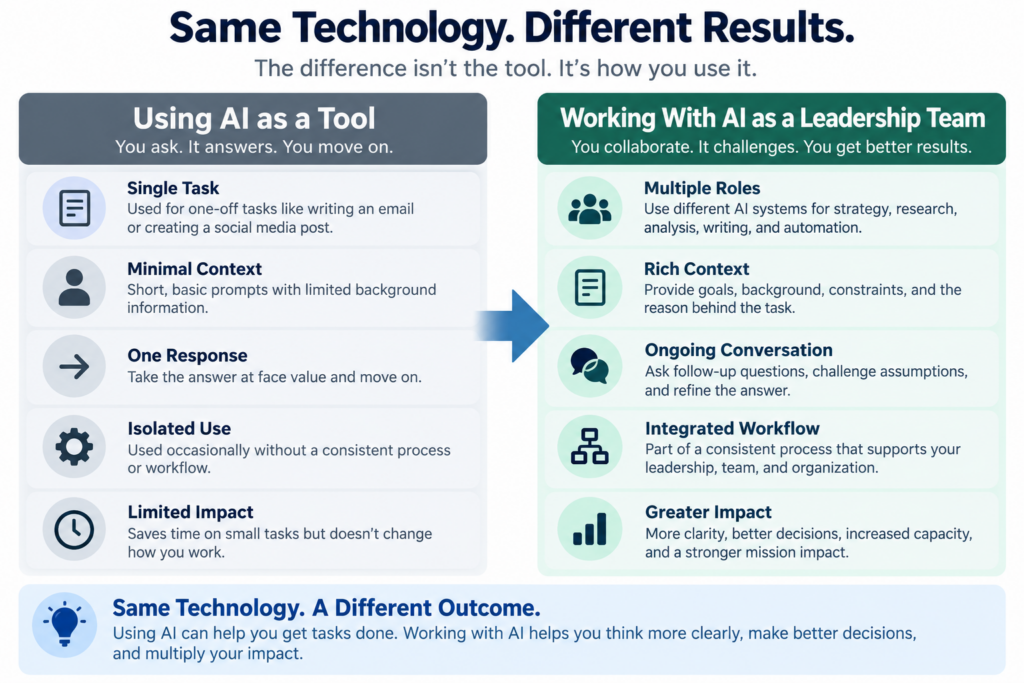
Most people ask:
“How can AI do this for me”?
A better question is:
“How can AI help me do this better
That one change completely altered how I approached artificial intelligence.
I stopped looking for a tool.
I started building a team.
Today I use different AI systems for different jobs:
- Strategy and decision support
- Research and current information
- Writing and documentation
- Automation and workflow
Just as you wouldn’t hire one employee to perform every role in your organization, you shouldn’t expect one AI to do everything well.
Choosing the right AI for the right job changes everything.
Better Questions. Better Results.
AI isn’t magic.
It’s management.
The quality of the output is directly related to the quality of the thinking behind the prompt.
The people getting extraordinary results from AI aren’t necessarily better at writing prompts.
They’re better at defining problems, providing context, asking better questions, and challenging the answers they receive.
That’s why I rarely accept the first response.
I ask another question.
Then another.
The conversation is where the value is created.
What’s Inside This Toolkit
This toolkit was built for nonprofit leaders who want practical ways to increase their effectiveness—not become AI experts.
Inside you’ll find:
- The leadership mindset that changed how I use AI
- A framework for working with AI instead of simply using it
- Ten prompts you can immediately adapt for your own organization
- Common mistakes and how to avoid them
- The AI workflow I use every week
- A curated list of AI tools worth exploring
- A quick-reference prompt guide you can keep at your desk
Everything in this toolkit comes from real-world use while leading Trusted World and building Mission Metrics.
These aren’t hypothetical examples.
They’re the workflows I rely on every day.
Start Here
If this is your first time using AI, don’t try to automate your entire organization.
Choose one task you dislike doing.
Use AI to help you complete it.
Then ask yourself one question:
“What could I do now that I couldn’t do before?”
That’s when AI stops being a novelty and starts becoming a competitive advantage.